
vSphere Kubernetes Service (VKS) Cluster Explained
Modern applications run in containers, and Kubernetes has become the standard platform for managing them. If your organization already uses VMware vSphere, you don’t need a separate Kubernetes infrastructure. With vSphere Kubernetes Service (VKS) formerly knows as Tanzu Kubernetes Grid Service (TKGs), you can run Kubernetes clusters directly on vSphere.
In this blog, we’ll learn :
- What is VKS?
- What is vSphere Supervisor ?
- High Level Architecture of VKS Cluster
- Key differences between Supervisor Cluster and VKS cluster (Guest Cluster)
What is vSphere Kubernetes Service(VKS)?
vSphere Kubernetes Service(VKS) is Supervisor Core Service(installed by default during supervisor enablement) which allows you to run Kubernetes clusters on top of vSphere infrastructure.
In simple terms:
- vSphere manages Virtual Machines
- Kubernetes manages containers
- VKS connects both together
This means you can create, manage, and upgrade Kubernetes clusters directly from vCenter.
What is vSphere Supervisor?
vSphere Supervisor is a special Kubernetes control plane that runs directly on ESXi hosts. It acts as the control layer between vSphere infrastructure and VKS clusters. Supervisor makes your vSphere environment Kubernetes-aware, if it isn’t enabled, you can’t create VKS clusters — so that’s the first prerequisite.
High Level Architecture of VKS Cluster
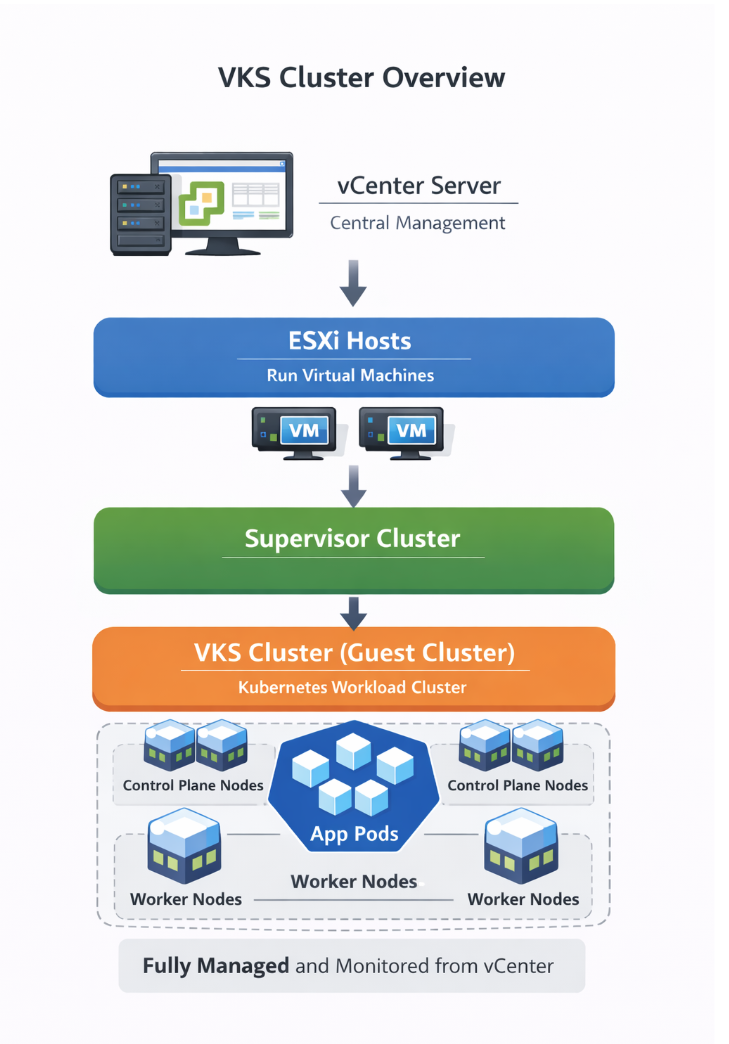
Key Components in the Architecture
vCenter Server
vCenter Server is the central management platform for the vSphere environment. It manages ESXi hosts, virtual machines, and Kubernetes infrastructure including Supervisor and VKS clusters.
ESXi Hosts
ESXi hosts are the physical servers running the VMware hypervisor. They provide compute resources where the Supervisor control plane and VKS cluster virtual machines run.
Supervisor Cluster
The Supervisor Cluster is the Kubernetes control plane integrated directly with vSphere. It manages namespaces and provisions VKS clusters within the environment.
VKS Cluster
A VKS cluster is a full Kubernetes cluster deployed inside a vSphere Namespace. It runs on virtual machines and is used by developers to deploy and manage application workloads.
Difference between Supervisor Cluster and VKS Cluster
In vSphere Kubernetes environments, understanding the difference between Supervisor Cluster and VKS Cluster is critical for platform design. The following table provides a clear side-by-side comparison.
| 🔎 Feature | Supervisor Cluster | VKS Cluster |
|---|---|---|
| Primary Purpose | Infrastructure control layer | Workload Kubernetes cluster |
| Main Responsibility | Manages namespaces & provisions clusters | Runs application workloads |
| Who Uses It? | Platform / Infrastructure Team | Developers / DevOps Teams |
| Created When? | When Workload Management is enabled | When user creates a cluster |
| Managed By | vCenter Server | Supervisor Cluster |
| Runs On | ESXi Hosts | Virtual Machines |
| Exposure to Developers | Limited | Full access |
| Architecture Role | Platform layer | Application layer |
Final Thoughts
VKS simplifies Kubernetes deployment inside enterprise environments. If you already use vSphere, enabling VKS is the fastest and most reliable way to start your Kubernetes journey.
Next Article: Step-by-Step Guide: Deploy and verify VKS Cluster using kubectl
Disclaimer
This blog is for informational and educational purposes only. The configurations, examples, and architectural guidance provided are based on general best practices and publicly available references.
Always validate configurations in a non-production environment before applying them to live systems. Features and integrations may vary depending on the versions of VKS, VKr, LCI, Supervisor and vCenter Server being used. The author is not responsible for any unintended impact caused by the use of this information in production environments.
Contents, and opinions are my own and do not reflect the opinions of my employer.